
Prostate Cancer Symptoms: Stage 1, 2, 3, 4
By Dr. Hemant B. Tongaonkar in Nanavati Max Institute of Cancer Care
Aug 05 , 2026 | 6 min read

Prostate cancer is a malignancy that begins in the prostate gland, a small, walnut-shaped organ located below the bladder and surrounding the urethra. The prostate plays a vital role in male fertility by producing seminal fluid that nourishes and transports sperm.
Prostate cancer develops when abnormal cells in the gland begin to multiply uncontrollably, forming a tumor. While many prostate cancers grow slowly, some types can be aggressive and spread rapidly to bones, lymph nodes, and other organs. Because of its slow growth in many cases, early-stage prostate cancer is highly curable when detected in time.
Understanding Prostate Cancer at a Glance
- Second most common cancer in men in metropolitan Indian cities
- Risk increases significantly after the age of 50
- Often asymptomatic in early stages
- High cure rates (>95% 5-year survival for localized disease globally; ~64% in India overall)
- Screening tests like PSA and DRE aid early detection
Regular health check-ups play a critical role in detecting the disease before symptoms appear. Early detection allows doctors to initiate treatment at a stage when outcomes are most favorable.
Causes and Risk Factors of Prostate Cancer
Although the exact cause of prostate cancer is still unknown, several risk factors have been firmly established.
Major Risk Factors
- Age: Risk rises sharply after 50 years
- Family History: Father, brother, or close relative with prostate or breast cancer (doubles risk)
- Genetics: BRCA1 and BRCA2 gene mutations
- Ethnicity: Higher incidence in men of African descent
- Obesity & Sedentary Lifestyle: Linked with aggressive disease
- Diet High in Saturated Fats: Associated with increased risk
- Hormonal Factors: High testosterone levels may promote cancer cell growth
Understanding these risk factors helps identify individuals who require earlier and more frequent screening.
Understanding Prostate Cancer Symptoms
Prostate cancer symptoms vary widely depending on the stage of disease. In early stages, the cancer may be confined to the gland and cause only mild urinary changes or no symptoms at all. As the tumor grows and spreads, symptoms become more pronounced and systemic.
Common Prostate Cancer Symptoms
- Difficulty starting urination
- Weak or interrupted urine stream
- Frequent urination, especially at night
- Pain or burning during urination
- Blood in urine or semen
- Erectile dysfunction
- Painful ejaculation
- Incomplete bladder emptying
- Pelvic discomfort
⚠️ These symptoms may also occur in benign prostatic hyperplasia (BPH). However, any persistent urinary change must be medically evaluated to rule out cancer.
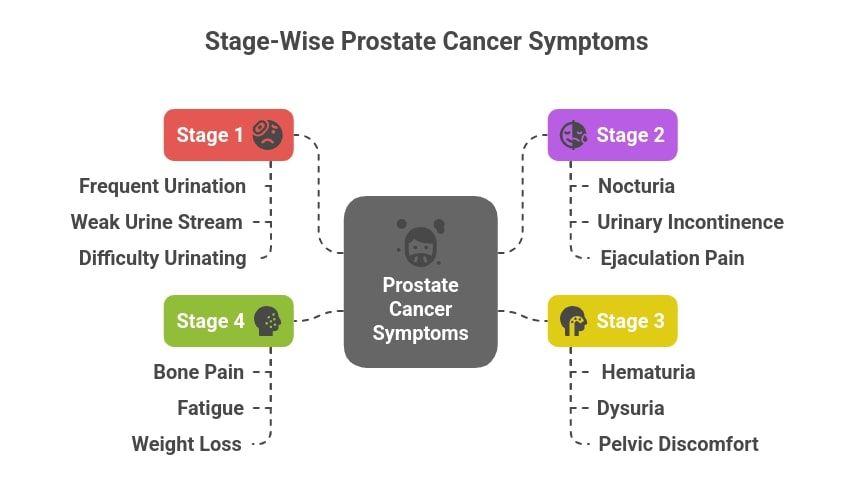
Prostate Cancer Symptoms by Stage
Prostate cancer is classified into four clinical stages. Each stage presents distinct symptom patterns.
Stage 1 Prostate Cancer Symptoms
Cancer remains confined to the prostate and is often found during routine PSA screening.
- Mild urinary frequency
- Slightly weak urine stream
- Typically asymptomatic
Stage 2 Prostate Cancer Symptoms
Cancer is still within the prostate but more extensive.
- Increased frequency of urination
- Difficulty holding urine
- Pain during ejaculation
- Early sexual dysfunction
Stage 3 Prostate Cancer Symptoms
Cancer spreads beyond the prostate into nearby tissues.
- Blood in urine or semen
- Pelvic or perineal pain
- Painful urination
- Erectile difficulties
Stage 4 Prostate Cancer Symptoms (Advanced/Metastatic)
Cancer spreads to distant organs such as bones, lungs, or lymph nodes.
- Severe bone pain (hips, spine, ribs)
- Weakness and fatigue
- Unintentional weight loss
- Anemia
- Difficulty walking
- Swelling of legs
Importance of Early Detection and Screening
Early detection dramatically improves survival outcomes in prostate cancer
Key Benefits of Early Screening
- Identifies cancer before symptoms appear
- Increases success rate of curative treatments
- Reduces complications and advanced disease
- Enables minimally invasive therapies
Who Should Get Screened?
- Men above 50 years
- Men above 45 with family history
- Men with genetic mutations (BRCA carriers)
Screening typically includes the PSA blood test and Digital Rectal Examination (DRE).
Diagnostic Tests for Prostate Cancer
Accurate diagnosis requires a combination of clinical assessment and imaging.
PSA Blood Test
Measures prostate-specific antigen levels. Elevated PSA may indicate prostate cancer, BPH, or infection.
Digital Rectal Examination (DRE)
Doctor palpates the prostate through the rectum to assess size, texture, and lumps.
Prostate Biopsy
Definitive diagnostic test. Determines:
- Cancer presence
- Gleason Score (tumor aggressiveness)
Imaging Tests
- MRI
- CT Scan
- Bone Scan
Used to evaluate cancer spread and staging.
Treatment Options for Prostate Cancer by Stage
Treatment depends on the stage, tumor grade, age, and overall health.
Active Surveillance
For low-risk slow-growing cancers with regular monitoring.
Surgery (Radical Prostatectomy)
Complete removal of the prostate gland.
Radiation Therapy
Destroys cancer cells using high-energy rays.
Hormone Therapy
Reduces testosterone levels that fuel cancer growth.
Chemotherapy
Used in advanced metastatic disease.
Palliative Care
Focuses on symptom relief and quality of life in late stages.
When to Seek Medical Attention for Prostate Cancer Symptoms
Seek immediate medical consultation if you experience:
- Persistent urinary obstruction
- Blood in urine or semen
- Severe pelvic or lower back pain
- Erectile dysfunction with urinary symptoms
- Unexplained weight loss and fatigue
Early medical intervention significantly improves treatment success.
Lifestyle and Prevention Tips for Prostate Cancer
While complete prevention is not guaranteed, risk can be reduced through:
- Balanced diet rich in fruits and vegetables
- Regular exercise
- Maintaining healthy BMI
- Avoiding smoking and excess alcohol
- Routine health check-ups
Frequently Asked Questions (FAQs)
1. What Is the PSA Test and When Should I Get It?
The PSA test measures prostate-specific antigen levels. Men over 50 or with family history should undergo regular testing.
2. How Can I Differentiate Prostate Cancer from BPH Symptoms?
Both cause urinary symptoms, but cancer may also cause blood in urine/semen, bone pain, and weight loss.
3. What are The Early Signs Of Prostate Cancer?
The early signs of prostate cancer often go unnoticed. However, some may experience increased frequency or difficulty in urination, discomfort while sitting and blood in the semen or urine. It's crucial to remember that these symptoms do not confirm prostate cancer but signal a need for medical consultation.
4. How Do Prostate Cancer Symptoms Progress Through Stages?
As prostate cancer stages progress, symptoms typically become more pronounced. In advanced stages, individuals may experience pain in the lower back, hips or thighs, unexplained weight loss, and fatigue.
5. Can Prostate Cancer Be Asymptomatic in Early Stages?
Yes, it's possible for prostate cancer to be asymptomatic during its early stages. This is why regular screenings are important for men above 50 years of age or those with a family history of the ailment.
6. What Tests are Available for Prostate Cancer Diagnosis?
The common diagnostic tests for prostate cancer include DRE, PSA test and imaging scans like MRI or CT scan. In some cases, a biopsy might be required to confirm the diagnosis.
7. Are Prostate Cancer Symptoms Always Noticeable?
Not necessarily. The symptoms of prostate cancer can be subtle and easily mistaken for less serious health issues related to ageing or lifestyle habits.
8. How Can Lifestyle Changes Impact Prostate Cancer Risk?
A healthier lifestyle can significantly reduce your risk of developing prostate cancer. This includes maintaining a balanced diet rich in fruits and vegetables, regular exercise, limiting alcohol intake and avoiding tobacco use.
9. What Treatment Options are Available for Different Stages of Prostate Cancer?
Prostate cancer treatment varies based on the stage and overall health status of the patient. Options include surgery (robotic prostatectomy), radiation therapy, hormone therapy and chemotherapy among others.
10. How Can I Lower My Risk Of Prostate Cancer?
Besides adopting a healthier lifestyle, getting regular screenings, particularly if you have a family history of the disease, can help detect the condition at an early stage when it's more treatable.
Conclusion
Prostate cancer is a highly treatable disease when detected early. Because symptoms often remain silent in the initial stages, regular screening becomes the most effective defense. Understanding prostate cancer symptoms by stage, adopting preventive lifestyle measures, and seeking prompt medical attention for warning signs dramatically improve survival outcomes.
Disclaimer
This article provides general educational information about prostate cancer and is not a substitute for professional medical advice, diagnosis, or treatment. Always consult a qualified healthcare provider for personalized screening recommendations, especially if you have risk factors or symptoms. Self-diagnosis or delaying care based on this content is not advised.
References
1. Mathur, P., Sathishkumar, K., Chaturvedi, M., Das, P., Sudarshan, K. L., Santhappa, U., ... & National Cancer Registry Program. (2023). Cancer incidence estimates for 2022 & projection for 2025: Result from National Cancer Registry Programme, India. Indian Journal of Medical Research.https://pmc.ncbi.nlm.nih.gov/articles/PMC10231735/
2. Sankarapillai, J., et al. (2024). Descriptive epidemiology of prostate cancer in India, 2012–2019. Indian Journal of Medical Research.
https://pmc.ncbi.nlm.nih.gov/articles/PMC11296585/
3. American Cancer Society. (2023). Prostate cancer signs and symptoms.
https://www.cancer.org/cancer/types/prostate-cancer/detection-diagnosis-staging/signs-symptoms.html
4. American Cancer Society. (2023). Risk factors for prostate cancer.
https://www.cancer.org/cancer/types/prostate-cancer/causes-risks-prevention/risk-factors.html
5. American Urological Association. (2023). AUA/SUO guideline: Prostate cancer screening. Journal of Urology.
https://www.auajournals.org/doi/10.1097/JU.0000000000003491
6. American Cancer Society. (2023). Initial treatment of prostate cancer, by stage and risk group.https://www.cancer.org/cancer/types/prostate-cancer/treating/by-stage.html

Written and Verified by:

Related Blogs

Dr. Manish Agarwal In Nanavati Max Institute of Cancer Care
Oct 06 , 2026 | 8 min read

Dr. Muzammil Shaikh In Nanavati Max Institute of Cancer Care
Oct 06 , 2026 | 2 min read

Medical Expert Team
Oct 06 , 2026 | 5 min read
Blogs by Doctor

Prostate Cancer: What is It & Types of Treatment?
Dr. Hemant B. Tongaonkar In Urological Cancer Program , Nanavati Max Institute of Cancer Care
Oct 06 , 2026 | 2 min read

Pap Smear Test: Importance, Procedure, and What Your Results Mean
Dr. Hemant B. Tongaonkar In Urological Surgeries Unit
Aug 05 , 2026 | 4 min read

Most read Blogs



Related Blogs
Dr. Manish Agarwal In Nanavati Max Institute of Cancer Care
Oct 06 , 2026 | 8 min read
Dr. Muzammil Shaikh In Nanavati Max Institute of Cancer Care
Oct 06 , 2026 | 2 min read
Medical Expert Team
Oct 06 , 2026 | 5 min read
Blogs by Doctor
Prostate Cancer: What is It & Types of Treatment?
Dr. Hemant B. Tongaonkar In Urological Cancer Program , Nanavati Max Institute of Cancer Care
Oct 06 , 2026 | 2 min read
Pap Smear Test: Importance, Procedure, and What Your Results Mean
Dr. Hemant B. Tongaonkar In Urological Surgeries Unit
Aug 05 , 2026 | 4 min read
Most read Blogs